
What Is Energy Choice?

May 31, 2022

Energy choice is the basis of what we do- but what is it?

Deregulated energy markets, commonly referred to as “energy choice” or “electric choice”, came about in 1992, with the creation of the National Energy Policy Act. This act addressed all aspects of energy creation, distribution, and consumption. Included in this was an outline for creating a competitive energy market by allowing groups other than utility companies to generate and sell energy supply. It was left up to individual states to decide if they’d like to take part in this new, deregulated, energy market.


         As of 2022, about half of states (plus Washington, D.C.) have deregulated the supply of natural gas or electricity, while only a handful have deregulated both. In these states, consumers have the right to choose which supplier they purchase their electricity or natural gas from. In addition to allowing consumers better control over their energy costs, energy choice also allows consumers the option of powering their properties with solar, wind, or other renewable resources. In most cases, the independent supplier will offer fixed-rate contracts ranging from one to five years in length, meaning that the consumer can protect themselves against fluctuating energy costs and inflation.


         So where do we come in? Electric Advisors does the hard part for you. We work with dozens of independent supply companies to build custom quotes based on your unique energy needs. After gathering these custom quotes, we present them to you in an easy-to-understand format and provide advice and input to help you make an informed decision. When you choose your own supplier, the only thing that changes is the “supply” line item on your bill. There is no disruption of service, no new fees from your utility company, and no new equipment to be installed. Energy purchased through an independent supplier will still be delivered by your local utility company.


         In short, energy choice allows consumers to choose how much they pay for their energy and how that energy is generated. It is a great option for consumers looking to gain more control over their energy costs, as well as those who may want to take advantage of renewable power without having to purchase their own equipment to generate it. Energy choice benefits everybody. If you’re interested in finding out what energy choice can do for your business, contact us today!   

By Russell Lacey April 17, 2026
For most business owners in Washington, D.C. and Maryland, June 1st marks the unofficial start of summer: the return of rooftop happy hours, tourists swarming the National Mall, and the inevitable cranking of the HVAC system. But in the world of energy management, June 1st is something much more significant. It is the "Energy New Year." If you manage a commercial property, a non-profit, or a restaurant, this date represents the reset button for how your utility costs are calculated for the next twelve months. While many decision-makers focus solely on the "supply rate" on their bill, there is a hidden mechanism called the Peak Load Contribution (PLC) that could be quietly inflating your costs by thousands of dollars The good news? You aren’t powerless. By understanding how the grid works and taking a few strategic steps this spring, you can "beat the surge" and secure better financial predictability for your organization. The June 1st Milestone: Why It’s the "Energy New Year" In the Mid-Atlantic region: specifically within the territories served by utilities like Pepco and BGE: we operate under the PJM Interconnection . PJM is the regional transmission organization that coordinates the movement of wholesale electricity across 13 states and D.C. Every year on June 1st, PJM begins a new "delivery year." This is the date when the "Capacity Tags" (or PLC) assigned to every commercial building are updated based on the previous summer’s usage. Why does this matter to you? Because the capacity charge often makes up 25% to 40% of a commercial electricity bill. If your building was inefficient during the hottest days of last summer, you are about to pay the price for it starting this June. Conversely, what you do this summer will dictate your fixed costs for June 2027 through May 2028.  The Hidden Problem: Understanding Capacity Charges and Your PLC Most business owners look at their bill and see "Kilowatt-hours (kWh)": that’s how much energy you used. But the Capacity Charge is based on your "Peak Load Contribution." Think of it like a "reservation fee" for the grid. PJM needs to ensure there is enough power available if every single building turned on every single light and AC unit at the exact same moment. To fund this readiness, they charge businesses based on their highest usage during the grid's "Five Peak Hours" of the previous summer. The Problem: If your restaurant, condo building, or school had a massive spike in usage on a Tuesday afternoon in July when the grid was stressed, your PLC (or Capacity Tag) will be high. You will then be billed at that "peak" rate every single month for the following year, regardless of how little energy you use in the winter. For many commercial clients, this is a "ghost charge" that feels impossible to control. But with the right services , it becomes a manageable variable.
By Russell Lacey April 10, 2026
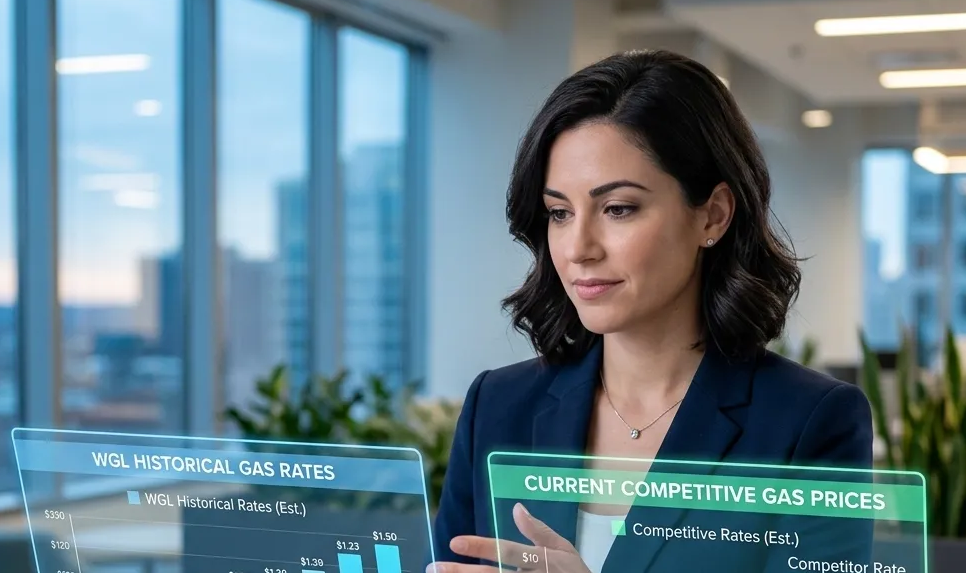
For business owners in Maryland, Washington, DC, and Virginia —right here in our backyard —energy costs are more than just a line item: they are a significant variable that can impact quarterly profitability and long-term operational planning. In recent years, the natural gas market has been characterized by notable volatility. From global supply chain disruptions to shifting domestic production levels, the price you pay for the blue flame in your furnace or the heat in your commercial kitchen has likely felt like a moving target. At Electric Advisors, Inc. , we believe that data-driven decision-making is the only way to effectively manage utility expenses. To help you understand where the market has been and where it is going, we have analyzed the historical procurement costs for Washington Gas (WGL) and compared them to the current opportunities available through competitive suppliers across Maryland, Washington, DC, and Virginia. The results are clear: across the WGL service territory in MD, DC, and VA , the cost of sticking with the utility’s default Purchased Gas Charge (PGC) may be significantly higher than many business owners realize. The Benchmark: Washington Gas Historical PGC Rates in Maryland, DC, and Virginia Every month, Washington Gas updates its Purchased Gas Charge (PGC) . This is the rate at which the utility passes through the cost of the natural gas it buys on the wholesale market to its customers. By law, the utility does not make a profit on the gas itself; they make their money on the delivery and infrastructure. However, the price they pay—and the price you eventually see on your bill—is subject to the fluctuations of the monthly wholesale market. For businesses in the broader WGL footprint, the important takeaway is this: Washington Gas default supply pricing and competitive market opportunities are consistent across its service territory in Maryland, Washington, DC, and Virginia. In other words, the same benchmark applies whether your business is in suburban Maryland, downtown DC, or Northern Virginia. Looking back at the last 24 months across the WGL service territory in MD, DC, and VA , we see a story of dramatic shifts: 24-Month Average WGL PGC: Approximately $0.68 per therm . The 2025 Spike: In April 2025, rates peaked at a staggering $0.8085 per therm . The 2026 Moderation: As of April 2026, the WGL rate has settled to $0.6382 per therm . While the 2026 rate is a welcome decrease from the highs of the previous year, it remains significantly higher than the rates seen a decade ago. For context, in 2010, the rate hovered around $0.32 per therm. We have seen a steady, long-term upward trend that necessitates a more proactive approach to commercial natural gas rates .
March 3, 2026
Helping Washington D.C. businesses take advantage of their sales tax exemption opportunities. Did you know that restaurants don't have to pay sales tax?