

Major Utility Companies Collaborate on PJM Expansion Project

November 18, 2024

The PJM Interconnection serves the Mid-Atlantic, as well as parts of the Midwest and Southern U.S.
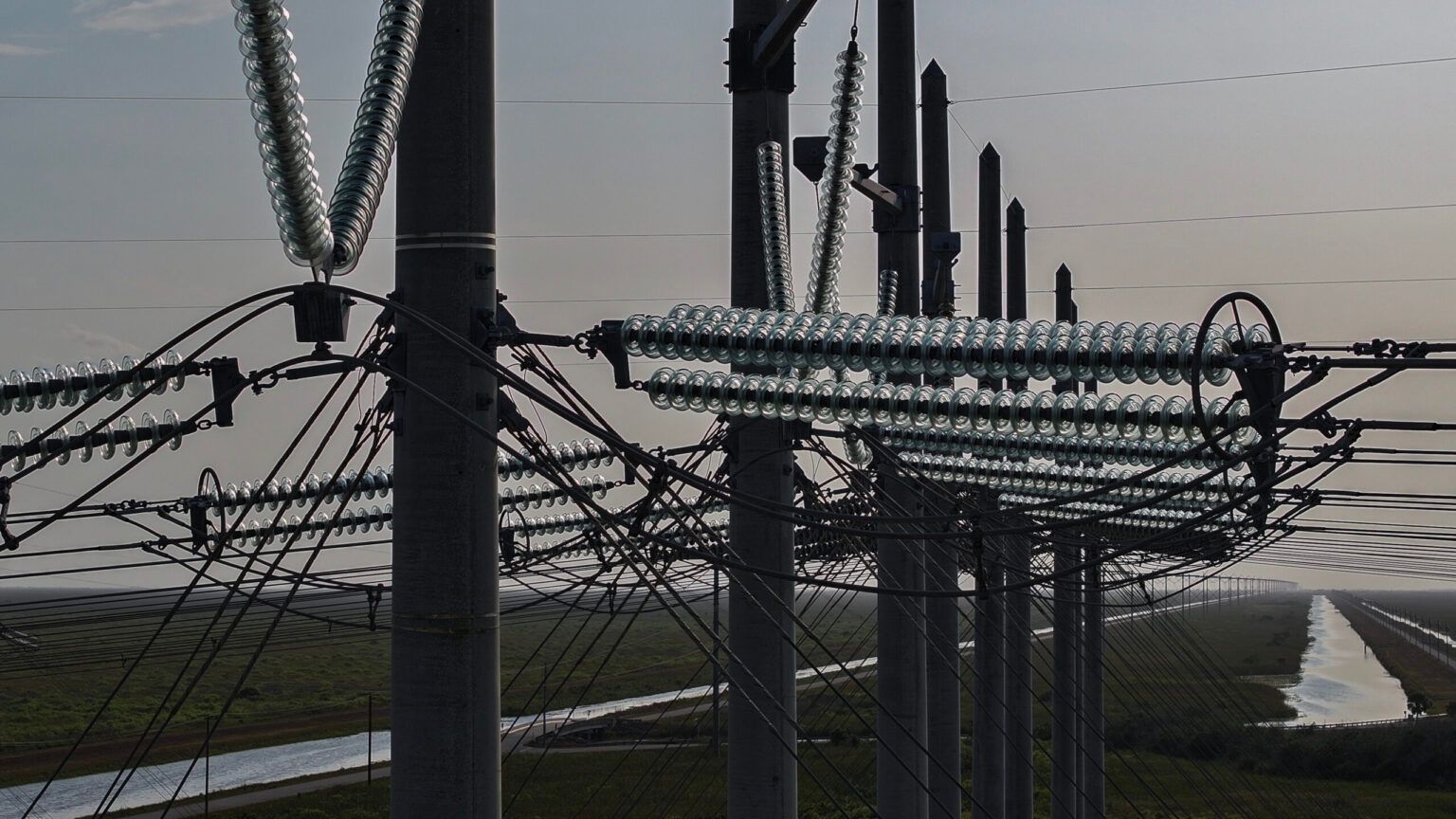
Rows of power line towers with insulators and wires in a rural landscape with canals.

The following article was originally published by The Southern Maryland Chronicle on Oct. 21, 2024.


In a first-of-its-kind collaboration, three major utilities — Dominion Energy Virginia, American Electric Power, and FirstEnergy Corp. — have come together to address the growing energy challenges within the PJM Interconnection footprint. These companies have proposed several regional electric transmission projects aimed at enhancing grid reliability and meeting future energy demands. PJM Interconnection oversees the movement of wholesale electricity across 13 states, primarily in the Mid-Atlantic and extending into parts of the Midwest and South.


The utilities’ joint planning agreement, announced in a press release from Dominion Energy, represents an innovative approach to meeting the region’s escalating energy needs. This collaboration is the result of increasing demand for electricity, driven by the rise of electrification and the expansion of data centers, particularly those supporting the artificial intelligence boom.


PJM’s regional footprint includes some of the nation’s most densely populated areas, where demand for power is expected to multiply significantly in the coming decade. A recent study by Americans for a Clean Energy Grid stressed the importance of PJM engaging in “proactive, scenario-based, long-term planning” to address the anticipated surge in electricity usage. As states in the PJM region pursue ambitious clean energy goals, utilities are being pushed to transition from traditional energy sources to renewable alternatives, creating further strain on the grid.


Virginia, known as the “data center capital of the world,” is a microcosm of the challenges utilities face across the PJM region. Aaron Ruby, a spokesperson for Dominion Energy, said that Virginia is experiencing “the largest growth in power demand since the years following WWII.” According to Ruby, power demand in the state is growing at an annual rate of more than 5% and is projected to double over the next 15 years — a growth rate that is nearly five times higher than what the state has seen over the past 15 years.


The joint effort by Dominion Energy, American Electric Power, and FirstEnergy is seen as a necessary step to address these increasing pressures on the grid. The companies’ proposal includes the construction of several new high-voltage transmission lines — specifically, 765-kilovolt (kV), 500-kV, and 345-kV lines — in key areas of Virginia, Ohio, and West Virginia. These projects were submitted to PJM’s Regional Transmission Expansion Plan (RTEP), a critical part of maintaining grid reliability in the face of growing demand.


Ed Baine, president of Dominion Energy Virginia, highlighted the significance of this collaboration, stating that the dynamic energy landscape requires more regional cooperation to build large-scale transmission infrastructure. “By leveraging the expertise and resources of three industry leaders whose transmission zones border one another, we’re better able to develop superior and more cost-effective solutions required to effectively resolve reliability issues across the PJM region,” Baine said.


The rapid pace of electrification and the shift to renewable energy has created unique challenges for utilities operating within PJM’s territory. As states move toward meeting their energy and climate goals, power providers are tasked with balancing the retirement of older, traditional energy sources with the integration of less familiar renewable options. The joint planning agreement aims to address these challenges by proposing large-scale infrastructure improvements that can support the region’s evolving energy needs.


Despite the urgency of the situation, it remains too early to determine the financial impact these projects will have on consumers. According to Ruby, PJM is not expected to select projects until early 2025. Even then, the installation and construction of the proposed transmission lines would take several more years to complete. Ruby explained that “if selected, they would then undergo a multi-year process for route selection, environmental and other field studies, and state and local permitting,” during which the cost implications for ratepayers would be evaluated.


In addition to the joint projects, Dominion Energy, American Electric Power, and FirstEnergy have also submitted proposals for other transmission initiatives to PJM, indicating a continued focus on improving the region’s energy infrastructure.

As PJM faces increasing demand and the challenge of integrating more renewable energy into the grid, the partnership between these three utilities represents a forward-looking approach to ensuring reliable and sustainable energy for the future.


You can read the original story here

By Russell Lacey June 24, 2026
For most business owners, the monthly utility bill is just another line item to be paid and filed away. You glance at the total, ensure it isn't astronomically higher than last month, and move on. But in 2026, with energy markets facing unprecedented volatility and complex new tariff structures, that "glance and pay" strategy is costing American businesses billions in overpayments. The good news? You don’t have to just accept these costs as the price of doing business. Everyone is talking about utility bill audits because they have transitioned from a "nice-to-have" occasional check to a critical financial strategy. At Electric Advisors, Inc., we’ve seen firsthand how a meticulous review of historical invoices can uncover significant refunds and permanent rate reductions. 
By Russell Lacey June 15, 2026
In the world of commercial operations, finding a way to slash overhead by double digits without spending a dime upfront is usually a red flag for a "too good to be true" offer. But in 2026, for businesses operating within the BGE, Pepco, Potomac Edison, and Delmarva utility territories across Maryland and Delaware, this isn't a sales pitch, it’s a regulatory reality. Community solar has evolved from a niche pilot program into a mainstream financial strategy for savvy business owners. If your business pays its own utility bills but doesn't have the roof space, the capital, or the long-term lease to install traditional solar panels, community solar is your bridge to immediate savings. The good news? You can typically reduce your monthly electricity spend by 8% to 12% simply by enrolling. Here is how your business can capture this "easy win." Key Takeaways Zero Upfront Costs: No installation, no equipment maintenance, and no capital expenditure. Guaranteed Savings: Most subscriptions offer a fixed percentage discount (typically 8–12%) on the solar credits applied to your bill. Tenant-Friendly: Perfect for businesses that rent their office, warehouse, or retail space. Market Reach: Available to businesses in BGE, Pepco, Potomac Edison, and Delmarva (MD & DE) territories. Risk Mitigation: Electric Advisors handles the vetting to ensure you choose a project with favorable terms and no hidden cancellation fees.
By Russell Lacey April 17, 2026
For most business owners in Washington, D.C. and Maryland, June 1st marks the unofficial start of summer: the return of rooftop happy hours, tourists swarming the National Mall, and the inevitable cranking of the HVAC system. But in the world of energy management, June 1st is something much more significant. It is the "Energy New Year." If you manage a commercial property, a non-profit, or a restaurant, this date represents the reset button for how your utility costs are calculated for the next twelve months. While many decision-makers focus solely on the "supply rate" on their bill, there is a hidden mechanism called the Peak Load Contribution (PLC) that could be quietly inflating your costs by thousands of dollars The good news? You aren’t powerless. By understanding how the grid works and taking a few strategic steps this spring, you can "beat the surge" and secure better financial predictability for your organization. The June 1st Milestone: Why It’s the "Energy New Year" In the Mid-Atlantic region: specifically within the territories served by utilities like Pepco and BGE: we operate under the PJM Interconnection . PJM is the regional transmission organization that coordinates the movement of wholesale electricity across 13 states and D.C. Every year on June 1st, PJM begins a new "delivery year." This is the date when the "Capacity Tags" (or PLC) assigned to every commercial building are updated based on the previous summer’s usage. Why does this matter to you? Because the capacity charge often makes up 25% to 40% of a commercial electricity bill. If your building was inefficient during the hottest days of last summer, you are about to pay the price for it starting this June. Conversely, what you do this summer will dictate your fixed costs for June 2027 through May 2028.  The Hidden Problem: Understanding Capacity Charges and Your PLC Most business owners look at their bill and see "Kilowatt-hours (kWh)": that’s how much energy you used. But the Capacity Charge is based on your "Peak Load Contribution." Think of it like a "reservation fee" for the grid. PJM needs to ensure there is enough power available if every single building turned on every single light and AC unit at the exact same moment. To fund this readiness, they charge businesses based on their highest usage during the grid's "Five Peak Hours" of the previous summer. The Problem: If your restaurant, condo building, or school had a massive spike in usage on a Tuesday afternoon in July when the grid was stressed, your PLC (or Capacity Tag) will be high. You will then be billed at that "peak" rate every single month for the following year, regardless of how little energy you use in the winter. For many commercial clients, this is a "ghost charge" that feels impossible to control. But with the right services , it becomes a manageable variable.